In short: You spot a plateau in your trend line, not on the scale. If the trend stays flat for three to four weeks, meaning less than about 0.2 lb (0.1 kg) per week, although you weighed yourself regularly, it is a real plateau. Anything shorter is almost always water. The four steps below let you check this in five minutes.
You have weighed yourself every morning for twelve days and the number has not moved. The question is not whether you are doing something wrong, but whether your curve is really flat. The scale alone cannot answer that, because a daily reading swings by 2 to 4 lb without any change in body fat. The answer is in the trend line.
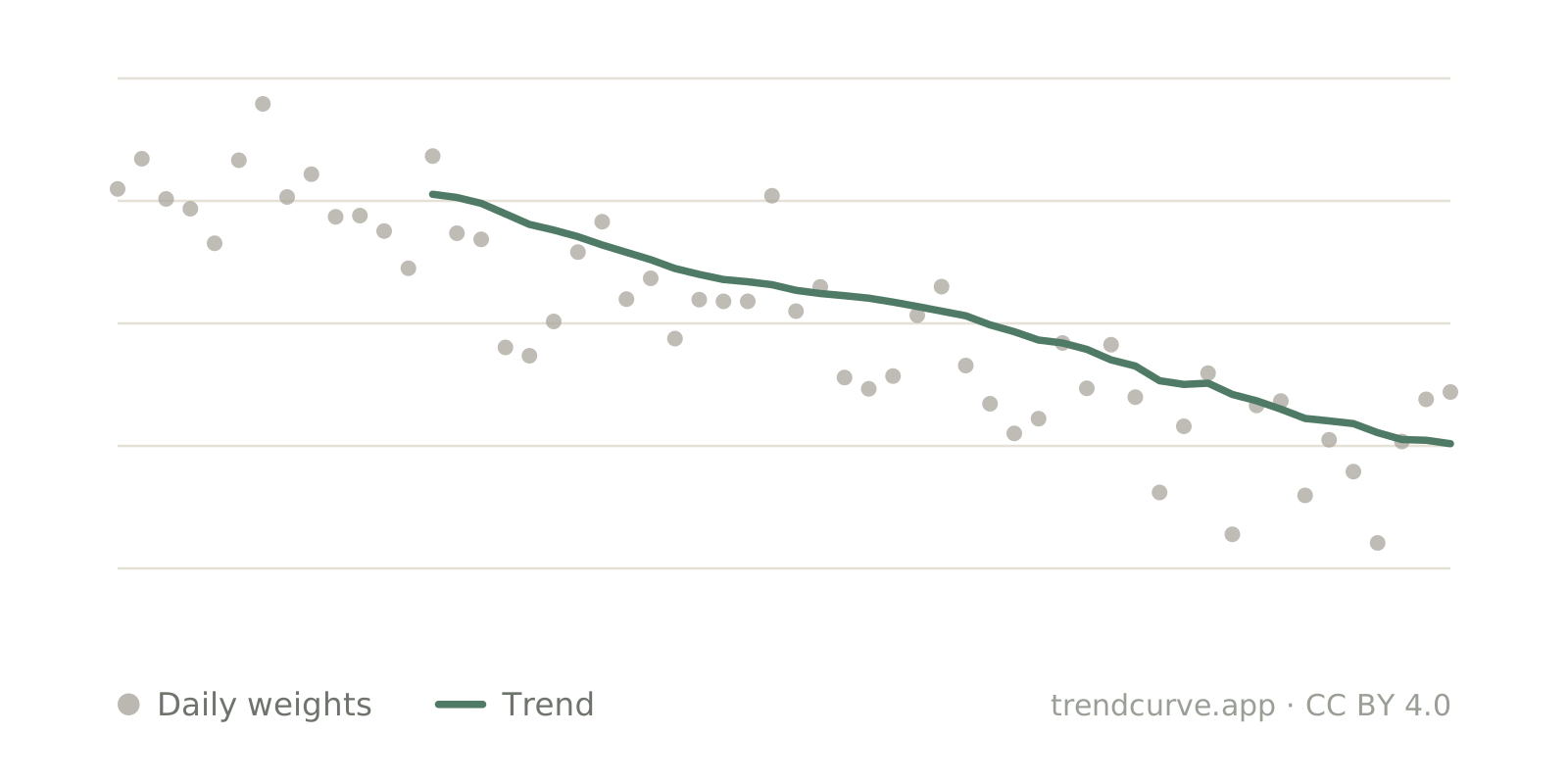
The chart shows the idea with sample data: the grey dots jump up and down, but the line still falls steadily. That line is what you need for the plateau question.
Step 1: Make your weight loss graph
No graph, no verdict: you need at least three to four weeks of weigh-ins as a trend line. Paste your readings into the free weight loss graph maker or load an export from Apple Health, Withings, Google Fit, Happy Scale or a CSV file. One line per reading with date and weight is enough. The tool runs in your browser and your data is not uploaded.
Several readings on one day are averaged. Missing days are fine as long as you weighed yourself on most days. Weighing once a week gives you a rough direction, but for the plateau question you need more points.
Step 2: Read the weekly rate, not the daily number
The number that matters is the weekly rate of your trend. The tool shows it in the result. It is the slope of the trend line over the last 14 days, so it moves much less than the difference between two weigh-ins.
| Weekly rate of the trend | What it means |
|---|---|
| more than 0.5 lb (0.25 kg) per week down | You are losing weight, even if the scale is stuck right now |
| 0.2 to 0.5 lb (0.1 to 0.25 kg) per week down | Slower, but not a plateau |
| less than 0.2 lb (0.1 kg) per week | Practically flat, go to step 3 |
| going up | Trend is rising, go to step 3 |
The Trendcurve app uses the same 0.1 kg per week threshold for its plateau detection. It is a rule of thumb, not a medical cut-off.
Step 3: Check how long it has lasted
A real plateau lasts at least three to four weeks. If the rate has only been below 0.2 lb for one or two weeks, it is usually a flat phase caused by water. Glycogen binds roughly three to four parts of water per part, and a salty weekend, a hard workout or your cycle can shift that amount by more than 2 lb.
An example with made-up but typical numbers: your trend falls by 0.9 lb per week for six weeks. Then come two weeks at 0.1 lb. In week nine it suddenly drops by 1.5 lb. Looking back, that was not a plateau but water hiding your fat loss for two weeks. Many people call the drop afterwards the whoosh effect.
Step 4: Rule out measurement problems
Before you change your plan, look at how you measured. A flat curve can also come from the way you weigh yourself:
- Few readings: if you weigh only two or three times a week, the trend looks calmer than it is.
- Different time of day: switching from mornings to evenings adds roughly 2 to 4 lb. The trend rises without any real gain.
- Different scale or floor: carpet, tile joints or a new scale shift every reading by a few hundred grams.
- Special weeks: holidays, illness, your period or a new medication can make you hold water.
If none of these apply and the trend has been flat for three to four weeks, you have a real plateau.
Why a real plateau happens
A real plateau usually happens because your energy needs went down and your portions did not follow. One kilogram of body weight corresponds to roughly 7,700 kilocalories according to Hall 2008. With every pound you lose you need a little less energy, and many people move less in daily life without noticing. A 500 kcal deficit at the start can shrink to zero after a few months.
The article Weight loss plateau or noise? How to read a flat trend explains this in more detail, with a calculation and a table to interpret your trend.
What to do about a real plateau
Change only one thing at a time so you can see in your graph what works. A proven order:
- Log everything honestly for one week, including oil, drinks and leftovers.
- Add everyday movement, for example a walk after dinner.
- Only then reduce portions a little.
- Or take a planned diet break of one to two weeks at maintenance.
Mark the day of every change. In the Trendcurve app, markers and experiments are free. The automatic plateau detection in the Patterns card is Pro: it shows "Plateau for X days" when the rate stays below 0.1 kg (0.2 lb) per week for several days. With the free weight loss graph maker you can do the same check by hand at any time.
If your weight stays flat for months although nothing has changed, if you take medication or if you have symptoms, talk to your doctor. Trendcurve is not a medical device.
Frequently asked questions
How do I know if I hit a weight loss plateau?
Look at your trend line, not the scale. If the trend stays flat for three to four weeks (less than about 0.2 lb or 0.1 kg per week) although you weighed yourself regularly, it is a real plateau. One flat week is usually water.
How long does a weight loss plateau last?
A flat phase caused by water usually lasts one to two weeks and often ends with a sudden drop. A real plateau lasts until your intake or activity changes, because your energy needs have fallen along with your weight.
Is it normal to not lose weight for 2 weeks?
Yes. Two weeks without visible change on the scale are normal for most people and not yet a plateau. Judge your trend after three to four weeks of regular weigh-ins.
What should I do about a real plateau?
Change one thing at a time: log everything honestly for a week, then add everyday movement, then reduce portions slightly if needed. Set a marker so you can see later when the change started to work.